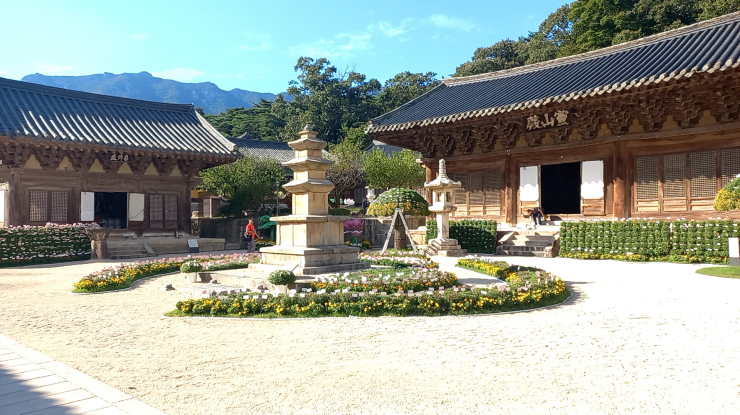
There are places in Korea where history isn’t just displayed behind glass—it is alive, breathing through ancient wooden pillars and echoing in the quiet rustle of pine needles underfoot. Tongdosa Temple (통도사) in Yangsan is exactly that kind of sanctuary.
As a UNESCO World Heritage site and one of Korea’s Three Jewel Temples, Tongdosa holds a special place in my heart. The moment you step onto the wooded path leading to the temple grounds, the noise of modern life simply fades away, replaced by the gentle murmur of stream water and the scent of fresh mountain air. Let me walk you through why this ancient haven should be a centerpiece of your Korean travels.
1. Introduction to Tongdosa (통도사)
Founded in 646 AD by the legendary Monk Jajang during the Silla Dynasty, Tongdosa Temple stands as the Buddha Jewel Temple among Korea’s Three Jewel Temples. What makes Tongdosa truly unique is that its main hall does not feature a traditional central Buddha statue. Instead, the temple enshrines actual sacred relics (sarira) of the Buddha, brought back from China by Monk Jajang, within a majestic stone pagoda courtyard known as the Geumgang Gyedan (Diamond Altar).
The name Tongdosa carries a deep spiritual meaning: “Passing through to reach enlightenment.” But even for those of us visiting simply to unwind, the temple offers an immediate sense of peace.
Walking through the sprawling complex, you will admire weathered timber architecture, intricate traditional painting details (dancheong), and stone bridges spanning crystal-clear mountain streams. Whether you are wandering through the temple grounds in early spring when the famous red plum blossoms (Jajangmae) bloom, or under the lush green canopy of summer, Tongdosa offers an atmosphere of timeless, unhurried grace.
2. How to Get to Tongdosa
Located at the foot of Mount Yeongchuk in Yangsan, Gyeongsangnam-do, Tongdosa is surprisingly accessible from major neighboring cities like Busan, Ulsan, and Daegu.
- By Public Transportation:
- From Busan: Take the Busan Metro Line 1 to Nopo Station (Busan Central Bus Terminal). From there, take an intercity bus to Tongdosa Shindoshi (Sinpyeong) Bus Terminal (approx. 25–30 minutes). From the terminal, it is a pleasant 10 to 15-minute walk to the temple entrance gate.
- From KTX Ulsan Station: Take express bus No. 3000 directly to the Tongdosa Bus Terminal area, taking around 20 to 25 minutes.
- By Car:
- Navigation Address:
108, Tongdosa-ro, Habuk-myeon, Yangsan-si, Gyeongsangnam-do(경남 양산시 하북면 통도사로 108). - Parking: Spacious parking lots are available right near the main entrance gates, allowing for easy access to the walking paths.
- Navigation Address:
💡 Personal Travel Tip: Don’t rush to take the shuttle or park right at the inner gate if you are able to walk. Take the ” 무풍한송길 (Path of Dancing Pines)”—a gentle 1.5 km trail leading from the outer gate to the main temple complex. Walking beneath pine trees that have stood for hundreds of years, bending over a tranquil stream, is half the magic of visiting Tongdosa.
3. The Scenery of 통도사


4. Map
5. Surrounding Information & Local Delicacies
Extending your visit to the area around Tongdosa reveals wonderful local food and serene side trips:
- Savor Traditional Wild Vegetable Rice (Sanchae Bibimbap): Just outside the temple gates, the village of Habuk-myeon is lined with cozy traditional restaurants. Be sure to try Sanchae Bibimbap (mountain vegetable rice bowl) or set meals served with freshly prepared seasonal wild herbs, savory soybean paste stew (doenjang-jjigae), and potato pancakes. It is a wholesome, nourishing meal that perfectly matches the temple experience.
- Explore Hermitages Nestled in the Mountain: Tongdosa is home to 19 smaller satellite hermitages (amja) scattered around Mount Yeongchuk. If you have extra time, follow the quiet walking paths to Amita-am or Seonam-am. These secluded retreats offer panoramic views of the surrounding peaks and an even quieter sanctuary for reflection.
- Tongdosa Fantasia & Ceramic Arts Village: For travelers visiting with family, the nearby Tongdosa Ceramic Arts Village offers hands-on pottery workshops, providing a creative takeaway from your journey through Yangsan’s cultural landscape.
Final Thoughts
Tongdosa is not a place you simply visit to check off a sightseeing list. It is a destination where you pause, take a deep breath, and let the quiet rhythm of history restore your energy. Whether you are sitting on the edge of a wooden porch listening to wind chimes or sipping warm tea after a walk among ancient pines, Tongdosa leaves a lingering warmth in your heart long after you return home.
Discover more from Creative Innovator in Korea
Subscribe to get the latest posts sent to your email.