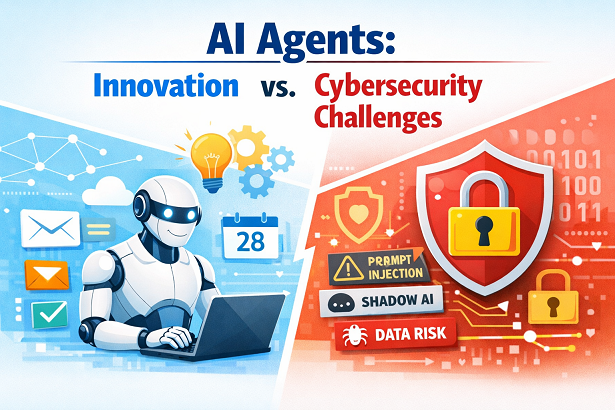
The tech world is shifting fast. AI agents are no longer just chatbots. They don’t just answer questions—they take action. They send emails, manage schedules, and even run code.
This leap in capability brings new risks. Security managers now face threats that didn’t exist a year ago. Let’s explore what AI agents are and how to secure them.
What Is an AI Agent?
AI agents are intelligent systems that do real work. They don’t just think—they act.
They understand your goals and carry them out. They can automate tasks like data analysis, customer support, and workflow execution.
Low-code and no-code platforms make this even easier. Anyone in your company can build an agent. You don’t need to be a developer.
This democratization boosts productivity. But it also opens the door to serious security gaps.
Five Major Security Risks You Can’t Ignore
AI agents offer convenience. But they also create new attack surfaces. Here are five threats you must monitor:
1. Prompt Injection Attacks
Hackers embed hidden commands in documents or websites.
Your AI agent reads them and executes the attacker’s instructions. It might leak data or change system settings without warning.
2. Excessive Privileges
Many agents get too much access.
Users grant admin rights for convenience. If an agent gets hijacked, the attacker gains full control instantly.
3. Visibility Gaps
Agents run thousands of tasks silently.
Security teams often can’t see what’s happening. This blind spot lets attacks unfold undetected.
4. Shadow AI
Employees build agents on unapproved platforms.
These rogue agents operate outside your security perimeter. They expose sensitive data to unmanaged environments.

5. Data Integrity and Bias
Agents learn from data. Bad data leads to bad decisions.
Biased or poisoned inputs can cause compliance violations or security failures.
How to Build a Secure AI Environment
You can’t stop innovation. But you can control it. Here’s your security playbook:
1. Enforce Zero Trust
Never trust an agent by default.
Give only the access it needs. Verify identity, device, and location. Assume every agent could be compromised.
2. Strengthen Governance
Document every agent’s purpose.
Use only approved platforms. Apply strict data protection rules. Keep audit logs for every action.
3. Monitor in Real Time
Set up dashboards to track agent behavior.
If an agent acts strangely, revoke its access immediately. Automation is key to stopping automated threats.

4. Update Incident Response Plans
AI changes how crises unfold.
Include AI failures in your business continuity plans. Monitor training data. Keep humans in the loop for critical decisions.
5. Build a Security-First Culture
Technology isn’t enough.
Train every employee on safe AI practices. Show that security enables innovation—not blocks it.
Final Thoughts: AI Security Is Survival
AI agents are powerful tools. They drive efficiency and innovation.
But without security, they become liabilities. Prompt injection, Shadow AI, and data poisoning are real threats.
Review your AI agent strategy today. Apply Zero Trust. Strengthen governance.
Security isn’t optional—it’s the foundation of sustainable innovation.
Tags: #AIAgents #Cybersecurity #PromptInjection #ZeroTrust #DataProtection #AIGovernance #ShadowAI #SecurityManager #EnterpriseSecurity #AIInnovation #AISafety #ThreatDetection #LeastPrivilege #TechTrends
Discover more from Creative Innovator in Korea
Subscribe to get the latest posts sent to your email.