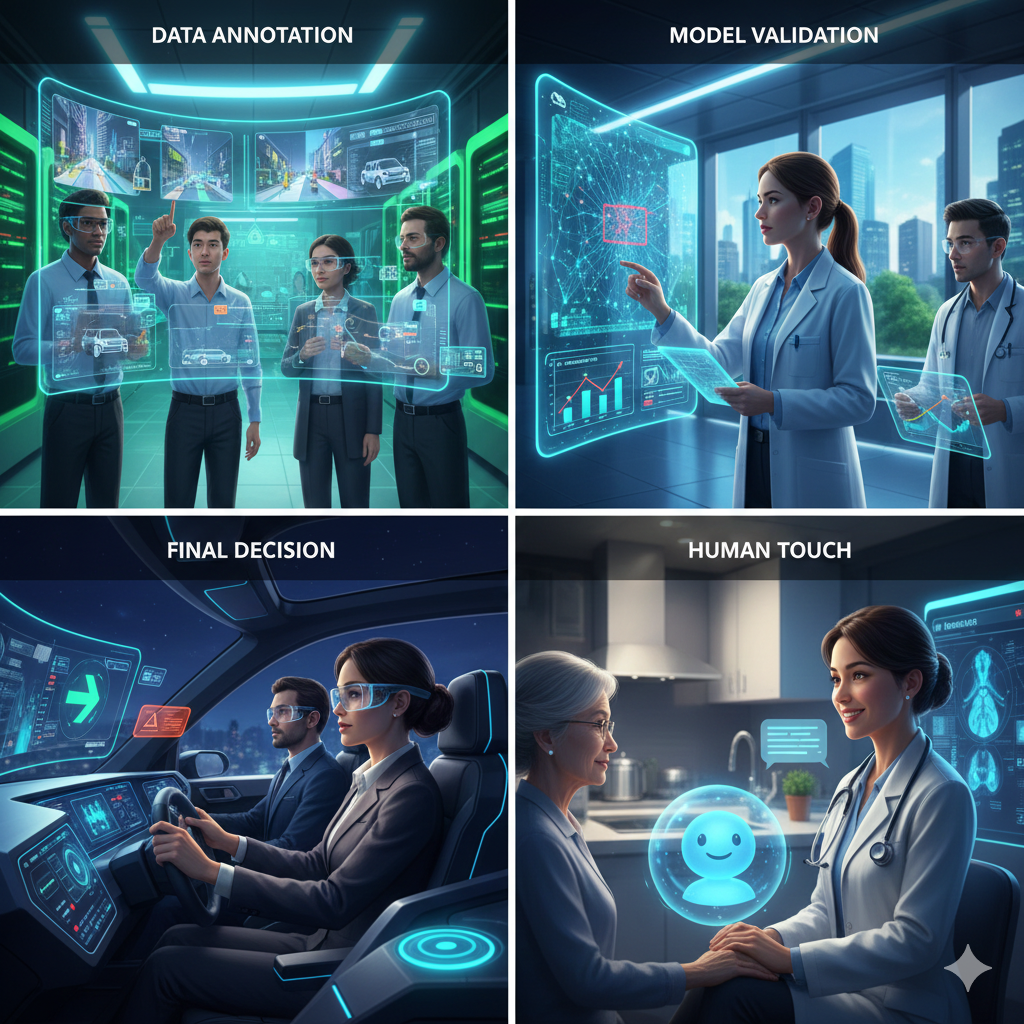
As Artificial Intelligence (AI) technology advances at an unprecedented speed, Korean society and global consumers face a new technological turning point in 2026. Contrary to vague expectations that AI will replace everything, experts are now focusing on the human element as AI’s essential partner. This strategy is known as “Human in the Loop” (HITL).

HITL is emerging as the most practical solution to overcome AI limitations and maximize its trustworthiness. This system design directly addresses current economic and technical realities.
1. 🔑 Why the Human is Essential: Defining ‘Human in the Loop’
In 2026, the human expert becomes the most critical partner within the AI ecosystem.
‘Human in the Loop’ (HITL) refers to a system architecture where human intervention is mandatory for key decisions or processes driven by AI. No matter how smart an AI system is, the final authority and accountability for its judgment must always rest with a human expert.
HITL fundamentally operates at three key stages of the AI lifecycle:
- Data Annotation: Humans lay the foundational groundwork for accurate AI judgment. They apply precise labels to the data used for AI training, for example, identifying objects within images. This ensures the AI learns from high-quality, verified data.
- Model Validation and Tuning: Experts regularly review the results produced by the AI model. They identify any unexpected errors or systemic biases, actively working to refine and improve the AI’s overall performance and fairness.
- Final Decision Making: In high-risk decisions that impact human life or significant assets (such as medical diagnosis or autonomous vehicle control), a human expert retains the ultimate sign-off authority.
2. 🛡️ The Crucial Role of HITL in the AI Era
As AI accelerates, society confronts its limitations and the associated ethical and social risks. HITL serves as the essential safety mechanism needed to manage these risks and enhance the social acceptance of AI.
2.1. The Solution for AI Error and Bias
No matter how vast the dataset an AI learns from, it cannot perfectly avoid the inherent limitations of that data or embedded societal biases. This is the root cause when AI makes unexpected errors or unfair decisions.
- Human Insight and Context: Human intervention helps the AI system. Experts capture subtle context, cultural nuances, or data biases that the AI might overlook. This dramatically improves the accuracy and fairness of the AI’s judgment.
- Risk Mitigation: In strictly regulated fields like finance and medicine, HITL acts as the final line of defense. It validates and corrects potentially fatal algorithmic decisions before they cause catastrophic consequences.
2.2. Clarifying Legal and Ethical Accountability
The ambiguity surrounding who holds responsibility when an AI makes a critical decision (e.g., an autonomous vehicle accident or an algorithm-driven termination) has been a major barrier to AI commercialization.
- Establishing Trust: The HITL system clearly assigns final legal and ethical responsibility to the human expert. This establishes a trust foundation that allows AI to be safely integrated and accepted by society. Human ethical judgment and accountability are becoming a new competitive advantage in the age of AI.
3. 🤝 2026 HITL Model: AI and Human Collaboration
In 2026, HITL will evolve beyond simple monitoring across business and consumer environments. It will become an advanced collaboration model that maximizes the strengths of both humans and AI.
3.1. Enterprise Environment: Efficiency Meets Strategy
AI excels at maximizing efficiency by analyzing massive datasets and providing optimized suggestions. Humans, conversely, apply ethical validity, long-term strategy, and empathy to make the final judgment.
| Sector | AI’s Role (Efficiency) | Human Expert’s Role (Trust and Responsibility) |
| Finance/Investment | Proposing portfolio optimization based on market data analysis. | Final investment approval considering unpredictable macro variables and ESG factors. |
| Manufacturing/R&D | Suggesting optimal design and process conditions through extensive simulations. | Final strategy decisions on technological innovation and compliance with safety regulations. |
| Human Resources (HR) | Objectively assessing the skills and potential of job applicants. | Final approval for sensitive decisions like termination and qualitative judgment on organizational fit. |
3.2. Consumer Environment: Speed Meets Human Touch
Consumers rely on AI for the speed of repetitive tasks but demand compassionate human intervention for issues involving their safety, health, or complex emotions.
- Medical Diagnosis: AI performs rapid, initial interpretation of medical images (CT, MRI), quickly identifying anomalies. However, a skilled physician takes responsibility for the final diagnosis, sensitive treatment planning, and empathetic communication, considering the patient’s full history and psychological state.
- Customer Service: AI chatbots handle over 95% of simple queries, significantly reducing wait times. For complex issues, such as emotional customer complaints or intricate refund/compensation problems, the customer is quickly connected to a human agent. This direct human intervention maximizes service quality and builds customer loyalty.
4. 🚀 Conclusion: HITL as the Competitive Edge
The year 2026 marks an inflection point where AI technology becomes fully integrated into society. At this stage, Human in the Loop (HITL) is no longer an obstacle to AI development. Instead, it becomes the ultimate competitive advantage, enhancing the AI system’s reliability, ethics, and completeness.
Companies must focus not only on adopting AI but also on designing the optimal junction where human expertise and ethical judgment meet AI efficiency. When critical decisions are required, only a hybrid system—reinforced by human empathy, insight, and accountability—will earn the lasting trust of consumers and the market.


Discover more from Creative Innovator in Korea
Subscribe to get the latest posts sent to your email.