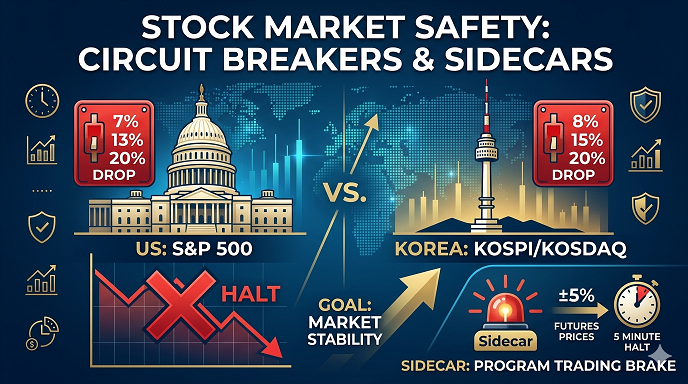
Stock markets can swing wildly during global crises, political shocks, or economic uncertainty. When volatility spikes, regulators activate tools to calm the chaos. Two of the most important tools are circuit breakers and sidecars.

These mechanisms protect investors and stabilize markets. They pause trading when prices move too fast, giving everyone time to breathe.
⚡ Circuit Breakers: Emergency Stop for the Market
A circuit breaker halts all trading on a stock exchange. It kicks in when the overall market index drops sharply within a short time.
In the U.S., the S&P 500 index triggers a 15-minute pause if it falls:
- 7% (Level 1)
- 13% (Level 2)
- 20% (Level 3, ends trading for the day)
South Korea uses similar thresholds for the KOSPI and KOSDAQ indexes:
- 8% drop → 20-minute halt
- 15% drop → another 20-minute halt
- 20% drop → trading ends for the day
These pauses help prevent panic selling and give investors time to reassess.
🚨 Sidecars: Temporary Brake for Program Trading
Sidecars are more targeted. They pause program trading—automated trades triggered by algorithms—when futures or options prices swing too much.
In Korea, a sidecar activates when index futures move ±5% from the previous day. It stops program trading for 5 minutes.
This tool doesn’t halt the whole market. It just slows down automated trades that could amplify volatility.
📉 Why Do These Tools Matter?
Markets move fast. Fear spreads faster. Circuit breakers and sidecars slow things down.
They protect retail investors from emotional decisions. They also give institutional traders time to adjust strategies.
Without these tools, sudden crashes could spiral out of control.
🕰️ Real-World Examples
- Black Monday (1987): The Dow Jones plunged 22.6% in one day. This led to the creation of circuit breakers in the U.S.
- COVID-19 Crash (2020): Circuit breakers triggered multiple times in March as global markets collapsed.
- Korea (2020): KOSPI and KOSDAQ both activated circuit breakers during pandemic panic. Sidecars also kicked in frequently.
These events show how critical these tools are during extreme market stress.
💡 What Should Investors Do When They Activate?
If a circuit breaker or sidecar activates, don’t panic. Use the pause wisely.
Here’s how to respond:
- Avoid panic selling: Emotional trades often lead to losses.
- Review your portfolio: Check your asset allocation and risk exposure.
- Hold cash reserves: Volatility creates buying opportunities.
- Stay diversified: Spread investments across sectors and regions.
- Watch the news: Understand the trigger behind the halt.
These steps help you stay calm and make smarter decisions.
🌍 Global vs. Local: U.S. and Korea Compared
| Feature | U.S. Market | Korean Market |
|---|---|---|
| Circuit Breaker | S&P 500 drops 7%, 13%, 20% | KOSPI/KOSDAQ drops 8%, 15%, 20% |
| Sidecar | No formal sidecar, but similar controls | Index futures ±5% → 5-min halt |
| Activation History | 1987, 2020 | 1998, 2008, 2020 |
Both systems aim to protect investors and maintain order. The triggers differ slightly, but the goal is the same.


📈 Final Thoughts: Stay Calm, Stay Informed
Circuit breakers and sidecars aren’t signs of failure. They’re safety nets.
When they activate, it means the market is under stress. But it also means regulators are watching and acting.
As an investor, your job is to stay informed, stay diversified, and stay calm.
Volatility is part of the game. Smart responses make all the difference.
Discover more from Creative Innovator in Korea
Subscribe to get the latest posts sent to your email.