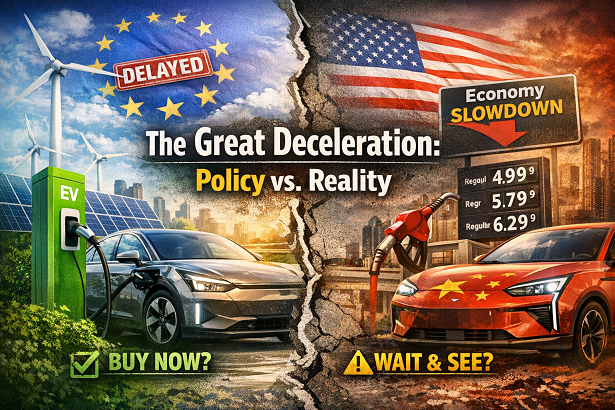
The Great Deceleration: Policy vs. Reality
For years, the narrative of the electric vehicle (EV) industry was driven by aggressive government mandates. However, 2025 and 2026 have marked a significant “reality check.” Governments in the West are recalibrating their timelines as economic pressures and infrastructure gaps collide with ambitious green goals.
- Europe’s Strategic Retreat: The EU has recently signaled a slowdown in its ESG and carbon-neutral regulations. The Corporate Sustainability Reporting Directive (CSRD) and related supply chain mandates have faced delays, with some targets pushed toward 2030. This provides legacy automakers like VW and Stellantis much-needed breathing room but risks slowing down the momentum of the green transition.
- The U.S. Regulatory Softening: In the United States, while environmental concerns remain high, the intensity of federal enforcement has softened. Policy shifts and the potential sunsetting of certain EV tax credits (IRA) have led many to believe the market is moving from a “policy-pushed” phase to a “consumer-pulled” phase.

Market Outlook: Should Global Consumers Buy Now?
As a global consumer, deciding whether to go electric in 2026 requires a balanced look at the pros and cons of the current environment.
✅ The Case for “Buy Now”
- Technological Maturity: By 2026, most EVs are no longer “beta versions.” Battery management and Over-the-Air (OTA) software updates have reached a high level of reliability.
- Price Wars: With Tesla and Chinese brands fighting for market share, prices for mid-range EVs are at their most competitive levels in years.
- Expanded Choice: The number of available EV models globally is expected to hit 1,000 by late 2026, offering everything from city cars to heavy-duty pickups.
⚠️ The Case for “Wait and See”
- Infrastructure Lag: Outside of major metropolitan hubs, charging anxiety remains a real barrier. If your region hasn’t caught up with High-Speed DC Charging, a Hybrid might be a safer bet.
- Depreciation Risks: High-tech vehicles evolve fast. Early adopters may face steeper depreciation compared to traditional internal combustion engine (ICE) vehicles.
- The Policy Fog: With shifting subsidies in Europe and the U.S., the “true cost” of ownership can change overnight.
The Elephant in the Room: The Chinese Global Offensive
While Western brands are hitting the brakes, Chinese automakers are accelerating. Brands like BYD, Zeekr, Polestar, and Xpeng are no longer just domestic players; they are global powerhouses.
- BYD (Build Your Dreams): BYD is targeting over 1.6 million overseas sales by 2026. Their secret weapon? Vertical integration. By making their own batteries and chips, they offer features at a price point that Western rivals struggle to match.
- Polestar & Zeekr: These brands, backed by Geely, focus on the premium segment. Polestar blends Scandinavian design with Chinese manufacturing efficiency, while Zeekr is winning fans with high-performance SUVs and luxury interiors.
- Xpeng: Often called the “Tesla of China,” Xpeng is leading the way in Autonomous Driving and smart cockpit technology, aiming to disrupt the European high-tech market.
Future Outlook: Competition Over Policy
The EV market is maturing. We are moving away from an era where people bought EVs just because of government incentives. In 2026 and beyond, the winners will be those who provide:
- Battery Reliability: Moving toward Solid-State or ultra-fast charging LFP batteries.
- Software Integration: A seamless digital experience inside the car.
- Price Parity: Making EVs as affordable as gas cars without the need for subsidies.
Final Verdict
The global EV shift is inevitable, but it is no longer a sprint. It is a marathon. For the global consumer, 2026 represents a year of diverse choices and intense competition. Whether you choose a legacy brand from Detroit or a tech-heavy newcomer from Shenzhen, the focus should be on your local charging infrastructure and the long-term service support of the brand.

Discover more from Creative Innovator in Korea
Subscribe to get the latest posts sent to your email.