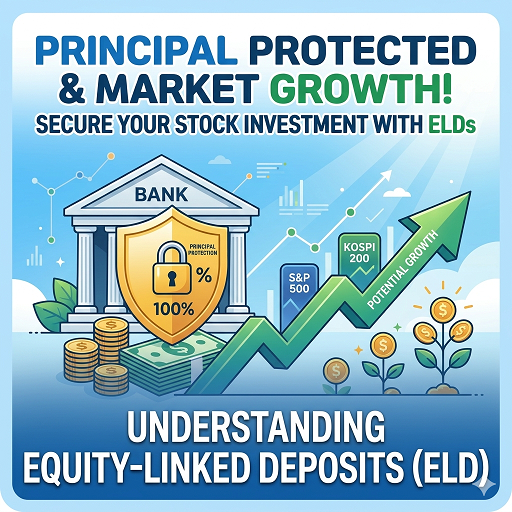
Bank deposit rates remain frustratingly low. Many savers feel stuck between safe but tiny returns and risky investments. What if you could protect your money while still enjoying market gains?

The answer lies in Equity-Linked Deposits (ELDs). These products combine the safety of traditional deposits with the potential of stock market growth. Let’s explore how they work, what benefits they offer, and what risks you must consider.
What Is an ELD?
An ELD is a special type of bank deposit. It guarantees 100% principal protection if you hold it until maturity. Unlike standard deposits, your interest depends on the performance of a stock index such as the KOSPI 200 or the S&P 500.
This structure allows conservative investors to participate in market growth without risking their savings.
How ELDs Generate Returns
Banks split your deposit into two parts:
- Safe Assets: Most of the money goes into secure investments like government bonds. This ensures your principal stays intact.
- Derivatives: A smaller portion funds options linked to stock indexes. If the index rises above a set threshold, you earn bonus interest.
For example, if the KOSPI 200 climbs 10% during the term, your ELD might pay 4–5% annually. That’s higher than the average savings rate of around 3%. If the index fails to meet conditions, you still receive a minimum guaranteed interest, often 0.1–1%.
Key Benefits of ELDs
✅ Principal Protection: Your deposit is safe as long as you hold it until maturity. Market downturns do not reduce your savings.
✅ Depositor Protection: ELDs qualify under the Depositor Protection Act. In Korea, coverage extends up to 50 million KRW per person.
✅ Market Exposure: You gain indirect access to stock market growth without buying shares directly. This makes ELDs attractive for cautious investors.
Important Risks to Consider
ELDs are safe but not simple. You must understand the contract before investing.
- Complex Profit Rules: Terms like Knock-in or Knock-out can change payouts. A rising market does not always guarantee high returns. Always ask your banker to explain conditions clearly.
- Early Withdrawal Penalties: Principal protection applies only at maturity. If you withdraw early, you may face penalties or even lose part of your deposit. Use funds you won’t need for at least one to two years.
ELD vs. ELS: Know the Difference
Many confuse ELDs with ELS (Equity-Linked Securities). The names sound similar, but the risk levels differ greatly.
| Feature | ELD (Deposit) | ELS (Securities) |
|---|---|---|
| Provider | Banks | Brokerage Firms |
| Principal Protection | 100% at maturity | Risk of loss |
| Legal Protection | Covered | Not covered |
| Risk Level | Low | Medium to High |
Remember: ELDs protect your money. ELS can lose it.

Who Should Consider ELDs?
ELDs suit conservative investors who dislike risk but want more than basic savings returns. They offer peace of mind with principal protection and a chance to benefit when markets rise.
If you want to grow your money without sleepless nights, ELDs may be the right choice. Visit your local bank, review current offerings, and check if the index conditions align with your market outlook.

Final Thoughts
In a low-interest era, ELDs provide a smart balance between safety and growth. They let you protect your savings while still participating in market opportunities.
With careful planning and clear understanding of terms, ELDs can help you achieve financial stability and better returns than traditional deposits.
Discover more from Creative Innovator in Korea
Subscribe to get the latest posts sent to your email.