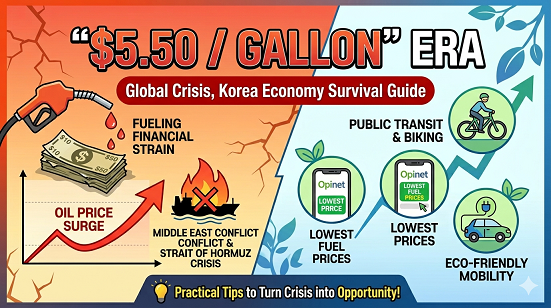
South Korea is currently facing a significant economic challenge. As the conflict between the U.S., Israel, and Iran continues without an end in sight, the threat of a blockade at the Strait of Hormuz and the Red Sea looms large. For a nation that imports nearly all of its energy, these geopolitical tensions translate directly to the price board at the local gas station.
For international observers and expats, seeing gasoline hit 2,000 won per liter (approximately $5.50 – $6.00 per gallon) is a clear signal of the “High Cost of Living” era in Seoul and beyond. This post explores how the Korean economy is reacting and how you can adapt your lifestyle to survive this fuel crisis.
🌍 The Global Context: Why Korea is Vulnerable
From an international perspective, South Korea is a “resource island.” It possesses world-class manufacturing but lacks domestic oil. When the Hormuz Strait—the world’s most important oil chokepoint—is threatened, Korea feels the shockwaves faster than almost any other developed nation.
- Energy Dependency: Korea ranks among the top global importers of crude oil. Any disruption in the Middle East immediately inflates the cost of production for Korean giants like Samsung and Hyundai.
- The Logistics Chain: The Red Sea is the gateway to Europe. Blockages there mean Korean exports must take longer, more expensive routes. This adds a “transportation tax” to every Korean product sold abroad and every item imported into the country.
- Currency Pressure: High oil prices often lead to a weaker Won against the Dollar. This double whammy means it costs more to buy oil, and the oil itself is priced higher.
For those watching from the US or Europe, the 2,000 won mark is a psychological and economic barrier. It marks the transition from “expensive” to “crisis-level” pricing that reshapes consumer behavior across the peninsula.
🚗 How the 2,000 Won Era Redefines Korean Life
When gasoline prices stay high, the very structure of daily life in Korea begins to shift. Here is what the new reality looks like on the ground:
- The Decline of the “Weekend Drive” The famous Korean “Outing” (Nadeuri) culture is changing. Instead of driving to Gangwon-do or Namhae for a weekend trip, more families stay within the Seoul Metropolitan Area. High fuel costs make a simple road trip a luxury expense.
- Inflation Beyond the Pump In Korea, “Gasoline at 2,000 won” is a leading indicator for food prices. Because trucks deliver everything from Jeju tangerines to Chonnam rice, your grocery bill at E-Mart or Coupang increases in sync with fuel prices.
- The Rise of Compact and Eco-Friendly Living The demand for large SUVs is cooling. In its place, there is a renewed interest in “Gyeong-cha” (compact cars) and electric vehicles. Efficiency is no longer a choice; it is a necessity for financial survival.
💡 Survival Strategies for the Energy Crisis
If you are living in or moving to Korea, you must adjust your financial strategy. Here are practical ways to mitigate the impact of high gasoline prices:
1. Master the World’s Best Public Transit
- The K-Pass Advantage: South Korea recently introduced the K-Pass. This system provides a percentage-based refund on public transit spending. It is the most effective way to decouple your budget from the price of oil.
- Intercity Excellence: Use the KTX or SRT for long-distance travel. When gasoline is 2,000 won, the train is often faster, cheaper, and much more comfortable than driving.
2. Digital Lifestyle and Delivery Optimization
- Bulk Online Shopping: Use platforms like Coupang or Market Kurly to group your purchases. This eliminates the need for multiple car trips to the supermarket.
- Remote Work Flexibility: If your company allows it, work from home. Saving just two days of commuting per week can reduce your monthly fuel consumption by 40%.
3. Smart Vehicle Management
- Use the “Opinet” App: This government-run app shows the real-time price of every gas station in Korea. Prices can vary by 100 won or more even within the same neighborhood.
- Self-Service Stations: Look for “Self” signs at gas stations. These stations offer lower prices by reducing labor costs, which helps when every won counts.
📈 Long-Term Outlook: A Future Beyond Oil
This crisis is accelerating South Korea’s transition toward a green economy. The government and major corporations are pushing for a future that is less dependent on Middle Eastern oil.
- Hydrogen and Electric Ambitions: Korea is betting heavily on hydrogen fuel cells and battery technology. This shift aims to insulate the domestic economy from future geopolitical shocks in the Middle East.
- Urban Design Changes: “15-minute cities” are becoming a goal in urban planning. The idea is to make work, shopping, and healthcare accessible within a short walk or bike ride, reducing the need for cars entirely.
Final Thoughts: Resilience in a Fast-Paced Economy
South Korea is famous for its “Pali-Pali” (hurry-hurry) culture and its incredible resilience. While 2,000 won per liter is a heavy burden, it is also a catalyst for innovation and smarter living. By adopting a “transit-first” mindset and utilizing Korea’s advanced digital infrastructure, you can navigate this high-cost era successfully.
Stay smart, stay efficient, and keep a close eye on the global headlines.


#KoreaEconomy #GasolinePrices #SeoulLife #EnergyCrisis #GlobalTrade #LivingInKorea #InflationWatch #PublicTransit #SustainableTravel #OilPriceShock #EconomicTrends #SmartLiving #ExpatsInKorea #KPass #HormuzStrait
Discover more from Creative Innovator in Korea
Subscribe to get the latest posts sent to your email.